
By Nige
There are times when I stop and think about just how many different things seem to be happening around Artecology at once. The past six weeks have certainly been one of those periods.
From coastal engineering and marine habitat creation to artificial intelligence, coral restoration, community craft and some interesting new possibilities for the future of our studio, there has been quite a lot going on. On the face of it, these might seem like quite different activities. But actually, they are all connected by a fairly simple idea: finding better ways for people and wildlife to share the places we inhabit.
And, as ever, a good deal of it starts here in Sandown.
A little more life in the places we’ve already built
One of the things I find particularly rewarding about our work is returning to places where we’ve introduced Artecology interventions and discovering what has happened in the meantime.
At Science Beach, our Vertipool installations continue to provide a fascinating opportunity to observe the relationships developing between different marine organisms and the structures we’ve introduced. Recent biodiversity reporting from my colleague marine biologist, Theo Vickers, has recorded 28 taxonomic groups associated with the installation. That’s not necessarily 28 individual species, but it is a useful indication of the diversity of life making use of these structures.
We’ve also been looking more closely at some rather curious behaviour. During one observation, a sea squirt appeared to contract almost immediately in response to the camera being brought in to take a closer look, before relaxing again. Repeated observations produced a similar response.
We don’t yet know exactly what was triggering it. It could be something as simple as a change in illumination or shadow, movement, vibration or another aspect of the recording process. But it’s a reminder that even the most apparently familiar organisms can surprise us when we take the time to look a little more closely.
It’s also why I remain such a fan of having somewhere like Science Beach on our doorstep. It is a living laboratory, but one that is accessible to anyone with a little curiosity.
Working with the coast, rather than simply defending it
A significant part of our work over the past few weeks has involved coastal infrastructure and the question of how we might make existing engineering work harder for nature.
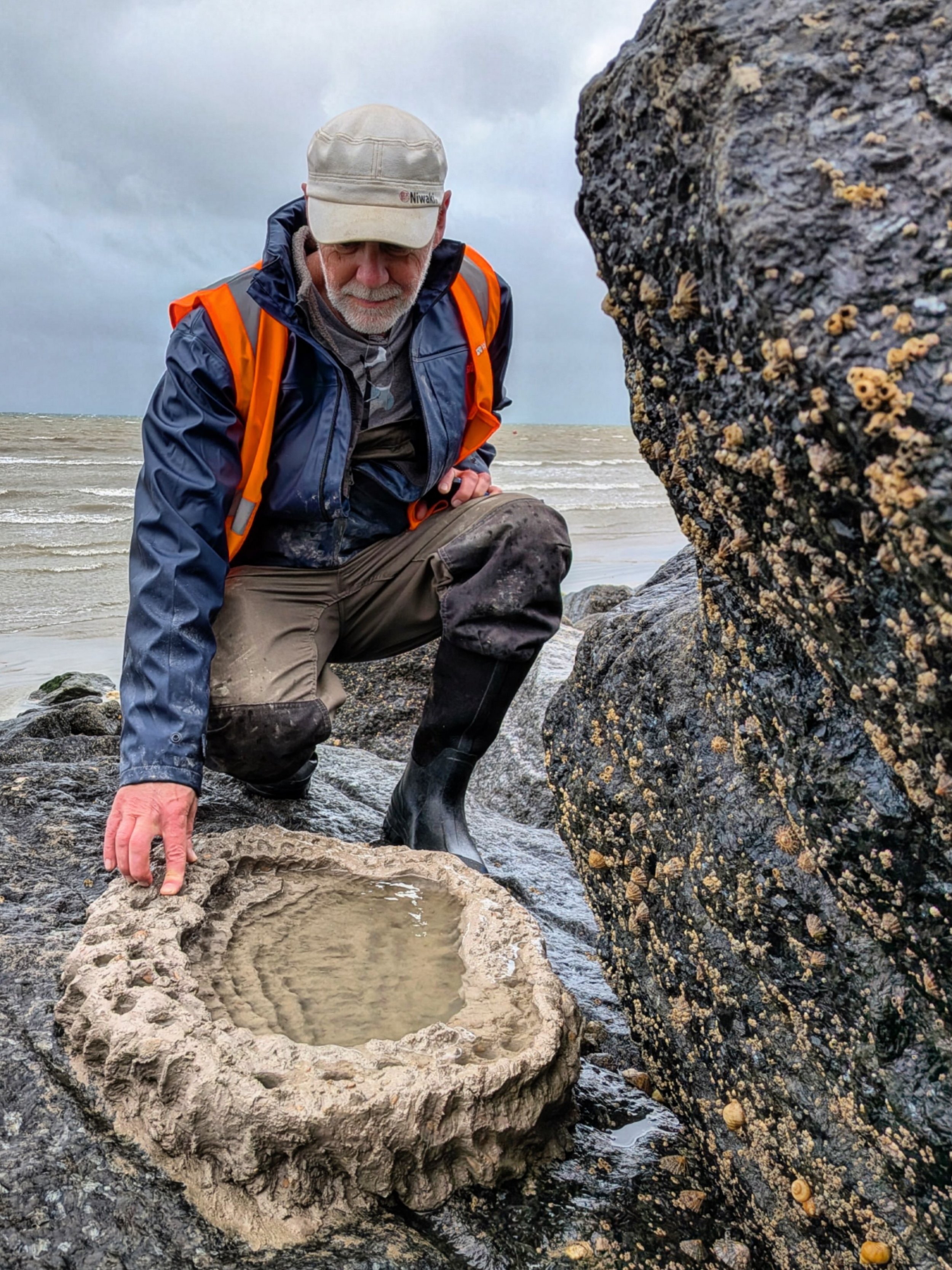
Our work at Elmer Beach with the Environment Agency (see photo) has been a good example of this. Alongside EA colleagues, VolkerStevin and other specialists, we’ve been exploring how Artecology methods and CoCreate ceramic artefacts can help introduce intertidal habitat opportunities to existing rock armour.
I particularly enjoy these sorts of collaborations because they bring together people with very different skills and perspectives. Engineers, ecologists, contractors, ceramicists and local people can all contribute something different. We’ve found that even where local communities aren’t directly involved in the making, people often become interested in what’s happening and offer to help with ongoing observations and monitoring.
Meanwhile, our work on wave overtopping mitigation continues to develop. The B-Type Vertipool approaches are part of an ongoing R&D effort to investigate whether devices like these can be retrofitted to existing coastal infrastructure and remain securely in place while also helping to reduce overtopping and creating additional habitat for coastal wildlife.
That is a deceptively straightforward question, but one with some pretty significant engineering challenges attached to it.
Our trials have already produced encouraging findings, including a substantial reduction in overtopping in wave-tank testing at the University of Plymouth. But there is still much to learn, particularly about how these systems behave in real-world conditions.
It’s important to acknowledge that this is research and development. There are unknowns, and the purpose of the trials is to address them. We’re not simply trying to prove that something we’ve already made works. We’re trying to establish what is possible, what needs changing and where the limitations might be.
For me, that’s an important distinction.
Artecology CoCreate: making a different kind of contribution
Artecology CoCreate continues to be one of the most interesting aspects of what we do.
The principle is simple enough. We invite people to make ceramic objects which become part of the habitat structures we design. Rather than producing a uniform collection of identical components, we deliberately encourage variety. Different shapes, textures, surfaces and forms create a greater range of opportunities for marine life.
But there’s something else happening here too.
People who might never otherwise have considered themselves contributors to ecological research or habitat creation become part of the process. Their ideas and creativity become physically embedded in the places we’re trying to improve.
We’ve been developing this thinking further through a new R&D programme being put together with my colleague Becca Skeels. We’re exploring how the skills and creative practices of older people, particularly knitting and crochet, might translate into ceramic bioreceptive forms.
The idea is to work with residents of a care home, drawing on their existing skills, experience and creativity to develop a collection of ceramic objects. These would then be developed through a process of making, prototyping and firing before being incorporated into habitat structures at Science Beach.
It’s still at the planning stage, but I think there’s something particularly valuable about the idea.
We talk a lot about intergenerational knowledge and the importance of involving communities in environmental work, but too often that involvement is limited to consultation or an occasional activity. Artecology CoCreate offers a way of making people’s contributions tangible, lasting and part of something bigger.
I think it also challenges some of our assumptions about where innovation comes from. Sometimes the next interesting idea isn’t found in a laboratory or design studio. It might be sitting in someone’s hands in an old folks home, waiting for an opportunity to be explored.
From coral reefs to the Solent
Our work with Future Oceans Foundation and The Coral Centre has also been keeping us busy.
In Bali, multiple CoralPods had been deployed a couple of months ago near a coastal town called Sanur. More recently Rob Peck from Future Ocean and local coral farmers started the process of attaching living coral to the CoralPods. It’s an exciting development for a project that has been more than five years in development here in the UK and that has brought together our approach to handcrafted complex bioreceptive structures with the practical requirements of coral restoration. This is about combining skills across disciplines and all important local knowledge.
Back here in the UK, Rob joined us to put the finishing touches to our CoralPod display unit ahead of its appearance at Venturefest South.
We spent some time applying the final bioreceptive detail layer to the outer CoralPod dome, including the connection points for living coral plugs. It’s a small detail in the overall structure, but an important one in demonstrating how the system is intended to work.
There are also some interesting conversations taking place around the potential for wider collaboration, although it’s too early to say where those might lead.
Closer to home, we’re also exploring a different marine habitat challenge with a University of Portsmouth PhD student. Our first KelpPod prototype has been made as part of an emerging project looking at opportunities for temperate kelp habitat creation in the Solent.
It hasn’t been deployed yet, the next stage is to develop the work towards deployment and trials over the coming year.
I find it fascinating that some of the same underlying design principles can be explored in such different ecological settings, from tropical coral reefs to temperate coastal waters.
Giving technology a closer look
Another interesting development has been our conversations with Shanker Prabhu and Shamsul Masum at the University of Portsmouth’s school of Electrical Engineering.
We’ve been exploring how artificial intelligence might help us make better use of the enormous amount of visual information generated by marine monitoring.
In particular, we’re interested in footage collected around our Vertipools in Poole Harbour. There is a considerable archive of underwater video, much of it recording mobile species moving around the structures.
The possibility of using AI to help identify organisms, detect movement and extract useful observations from that footage is an attractive one. It could potentially make the process of monitoring much more efficient and help us understand ecological changes that might otherwise be missed.
We’re at the early stages of exploring this, preparing sample footage and timestamps to investigate what might be possible.
It’s another example of something I find increasingly important: combining traditional ecological observation with new technologies, without losing sight of the natural systems we’re actually trying to understand.
Making room for what comes next
There’s been some thinking closer to home recently too.
We’ve been developing proposals for changes to our studio and manufacturing space in Sandown. The intention is to relocate the more demanding manufacturing activity into a small, purpose-built annex alongside the existing building, allowing us to open up the main studio and create a much more flexible space for meetings, visitors, students, research and collaborative making.
It’s still a proposal, but it reflects something we’ve been thinking about for a while. We think that as continues to Artecology develop, the physical space in which we work needs to develop with it.
We want the studio to become an increasingly useful place for people to come and see what we do, understand how we do it and, most importantly, get involved.
That’s particularly relevant as Sandown itself explores its future as a place where arts, culture, science and nature might come together in new ways. Our town’s shortlisting for the UK’s first Town of Culture is an exciting opportunity, and one that resonates with much of what we’ve been working towards here for years. We were delighted to host a small videography team from DCMS to our studio and Science Beach recently. It was inspiring to see their very real interest in this place, and to see them genuinely excited to be in our studio.
I have always believed that Sandown is a rather special place to do this work. Artecology grew out of the opportunities and challenges presented by this particular stretch of coastline. In many ways, it couldn’t have happened anywhere else.
All connected
Looking back over the past few weeks, what strikes me isn’t necessarily the number of projects or the range of things we’ve been doing. It’s the connections between them.
A coastal engineering project becomes an opportunity to create habitat. A ceramic workshop becomes a contribution to ecological research. A care-home activity becomes an exploration of intergenerational knowledge. An archive of underwater footage becomes an opportunity to use artificial intelligence to understand marine biodiversity.
These aren’t separate activities bolted together under the banner of sustainability. They’re different expressions of the same way of thinking.
We often talk about Nature Inclusive Design, but for me it has always been about more than designing better structures or introducing more habitat. It’s about finding ways to put people back into the biota, recognising that we’re part of the living systems around us rather than somehow separate from them.
And perhaps that’s the most encouraging thing about the work we’re doing. It keeps creating opportunities for people who might not otherwise meet, ideas that might not otherwise be explored and relationships between people and wildlife that might not otherwise develop.
There’s plenty more to do, plenty we don’t yet know and a fair amount still to work out.
But of course that’s rather the point.